


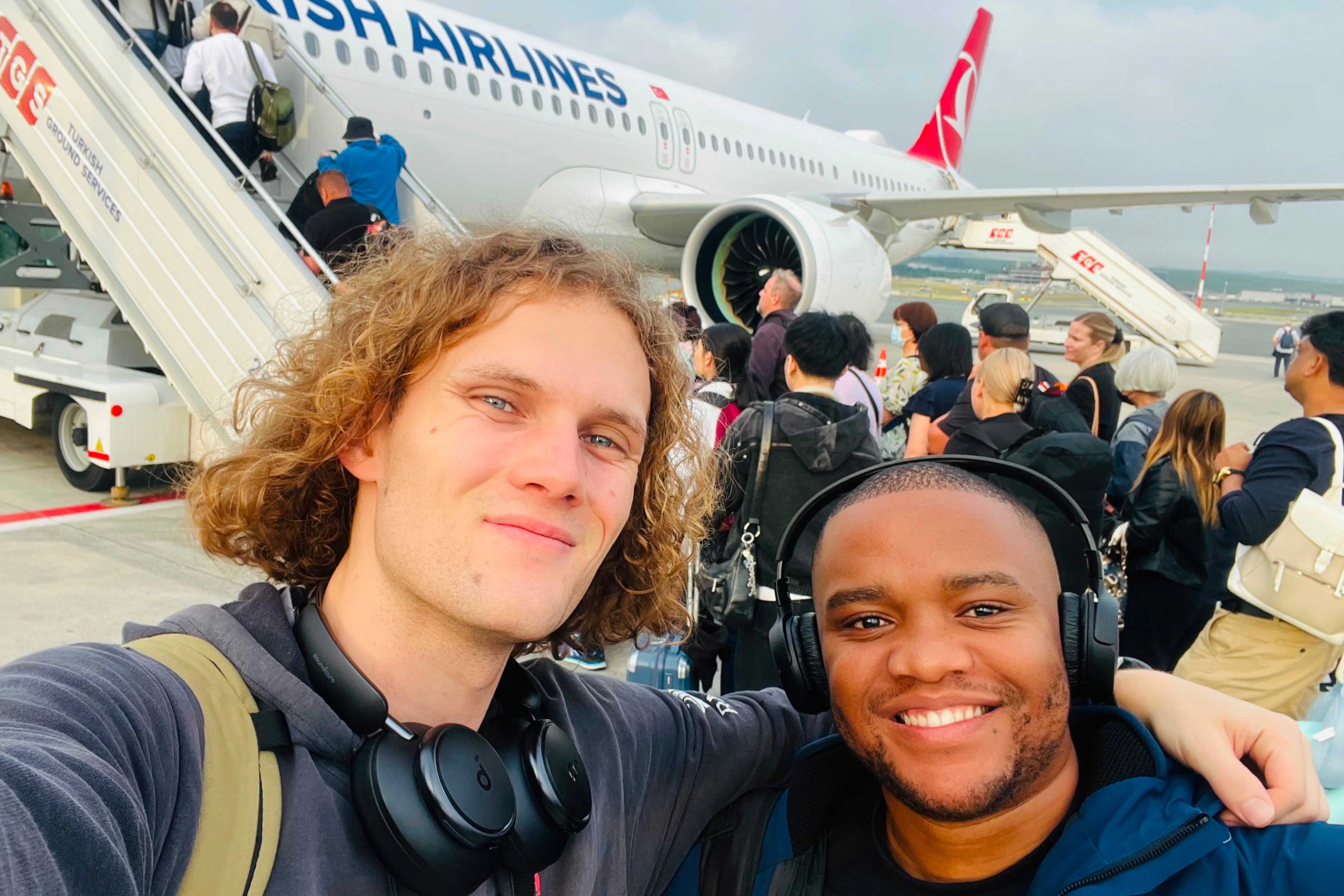
My most recent newsroom chat with Future in the Humanities (FITH) fellow Karabo Mohapeloa opened with a question about his “first hackathon experience”, and I didn’t get to the end of the sentence.
“Not really my first, actually.”
It was his fourth. Turns out, while he was an undergraduate at the National University of Lesotho circa 2019, Karabo won the second one he took part in. The event, structured as a competitive challenge, was hosted by the Lesotho Revenue Authority (LRA), now rebranded as Revenue Services Lesotho (RSL). He split the prize, thirty-five thousand rand equivalent (~USD 2,420), with his hackathon partner and former colleague at Enigma, Bokang Thoola. Karabo was interning at the Maseru software company, while Bokang was a little further along his professional trajectory and is now a software engineer at Vodacom Lesotho.
Their prize-winning solution put retail transactions on a blockchain so they couldn’t be altered after the fact, and ran anomaly detection across the chain to catch VAT declarations that didn’t reconcile. It was apparently one of several impressive innovations to come out of a hackathon that turned dev teams loose on real-world challenges the RSL was facing in delivering on its mandate, with blockchain and AI tools in the mix.
Well, so much for my presuppositions... What I had come to distil were the takeaways of two scholars researching within Wits’ SA–UK SARChI Chair in the Digital Humanities, dispatched to Finland for a Digital Humanities hackathon. One of them (Karabo) had never been on a plane, which later turned out to be the least interesting thing about the assignment and the insights that flowed out of their experience.
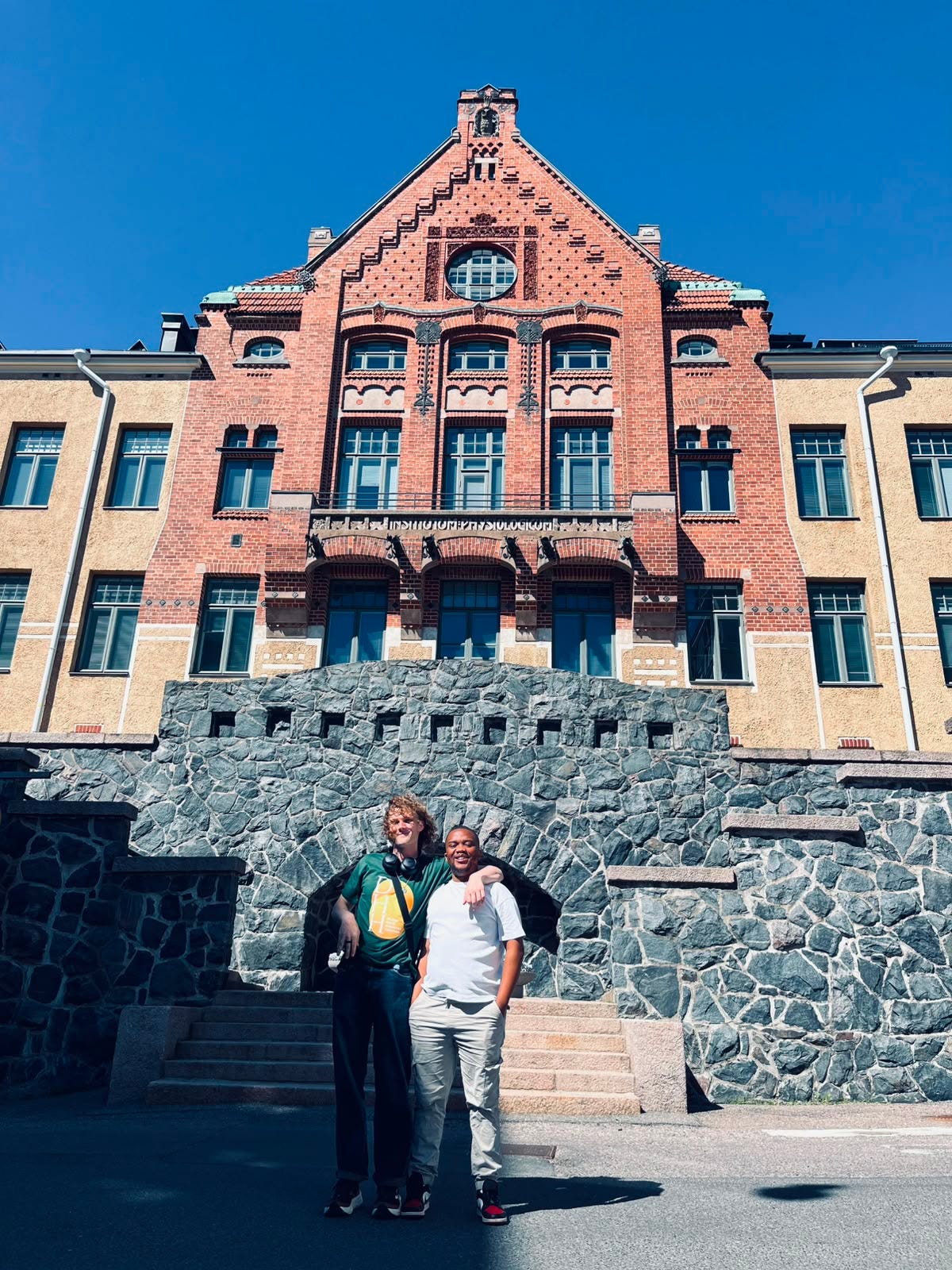
It’s worth letting you in on who these two are.
Karabo is Mosotho and, until he came to Wits for his honours degree in 2025, had spent his entire life in Lesotho, raised in a respectable black middle-class family. Before the master’s he spent nearly three years building software at Enigma in Lesotho’s capital, then two years and eight months with ICAP at Columbia University on district health information systems, writing Python to move patient data between registries and training district health teams to use it. The chap’s twenty-seven, and somewhere in there he entered four hackathons and won one of them.
Those facts go some way to correcting a few lazy assumptions. Lesotho has a revenue authority that runs hackathons, a software industry that hires and promotes young talent and a UNDP hackathon that put a room of people (Karabo among them) to work on building a corpus for Sesotho. What it does not have, for a great many capable people, is a reason or a route to get on a plane before your late twenties. Karabo, evidently, found both anyway.
Max Milella came up through St John’s College, read languages and literature at the University of Pretoria and stayed for an honours in applied linguistics, wrote consumer technology pieces for Stuff South Africa and copy for a speciality coffee retailer, then came to Wits for an MA e-Science in social data science. The e-Science programme was built to teach statistical and computational techniques to people trained in other domains. Max is in many ways a classical humanities purist who, oddly enough, went looking for the quantitative rather than fielding it reluctantly.
So it’s kind of Karabo (Digital) and Max (Humanities); between them making the case for why the Chair needs both halves.
The field is relatively young globally and younger here. It needs people like Karabo, computer scientists who could be doing reinforcement learning in a lab and choose this instead. It equally needs people like Max, who describes himself as a big fan of good words and sentences, and who went and got the statistical training to build practical, useful things on that foundation. Both sorts of researcher have to commit their careers (and lives) to advancing the field if this Chair and other similar initiatives in the Global South are to become serious institutional platforms and engines for work that shapes the real world most non-academic humans inhabit.
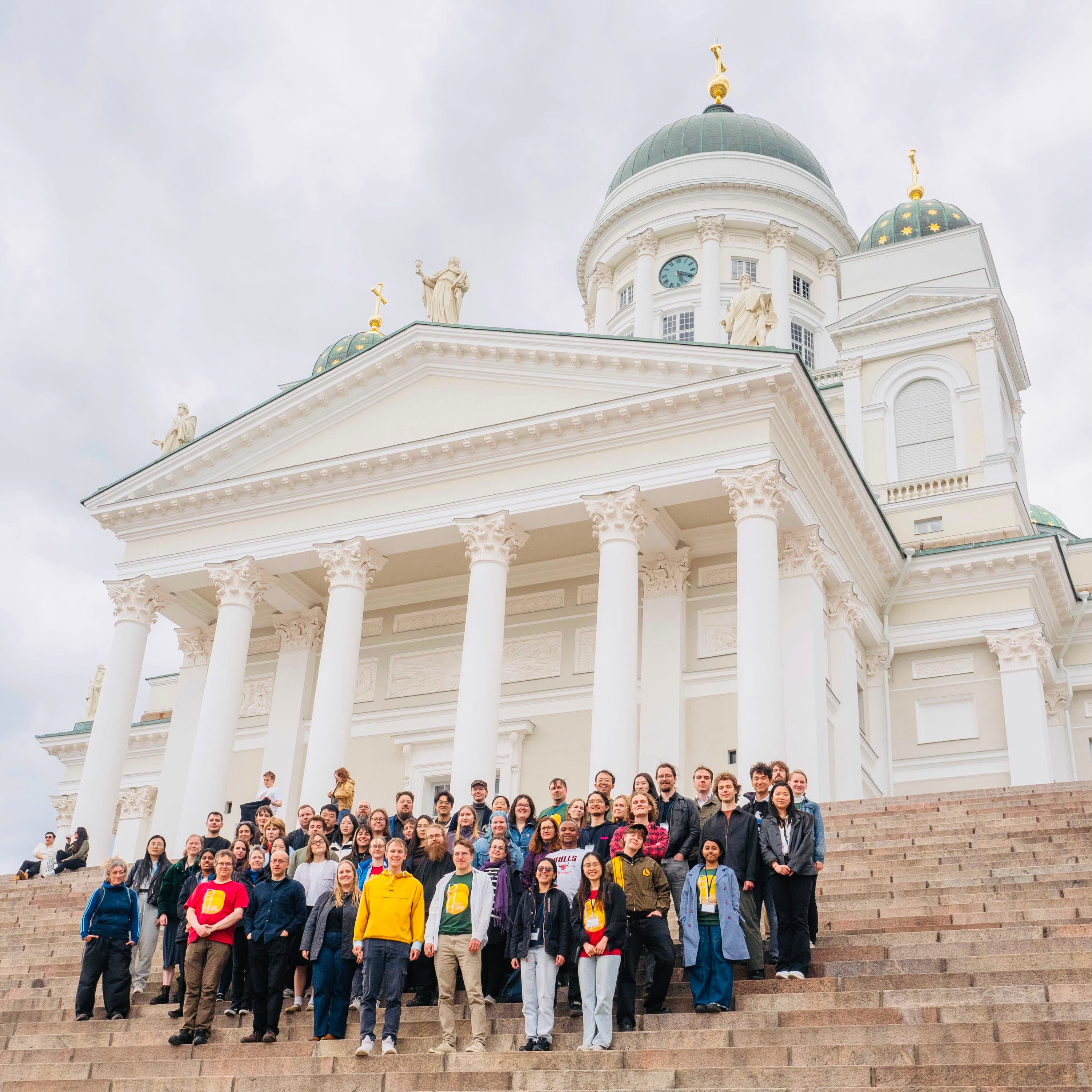
The University of Helsinki has run its Digital Humanities Hackathon eleven times since 2015. This year it ran from 20 to 29 May and drew around sixty researchers working in groups of ten, with two or three team leaders apiece. The lot of them were given six and a half working days to go from a standing start to a scientific poster. The format was decidedly non-competitive, so no winners, with the reward being participation.
Five themes were published in advance, namely: Finnic oral poetry; True crime in Britain in the 19th century; Knowledge production across 200 million books and 600 years; Foreign nations in national policy debates (Parliaments Beyond Borders); and Corporate and legal rhetoric (Language of Profits).
It wasn’t so much a menu as an agenda, with every item assembled out of European archives, held by European institutions and answering questions Europe has been asking itself for some time. Some themes recur between editions, and most of them arrive attached to a supervisor’s existing research, with a corpus already curated.
Admission is fairly competitive, and participants tend to be based at European universities. It’s technically open to anyone, though, provided they can commit to the full ten-day programme (including the two mandatory online preparatory sessions), and can demonstrate the expertise, in the humanities, social sciences, computer science or a related discipline, needed to contribute meaningfully to one of the themed multi-disciplinary research groups.
The initial plug came in late 2025, when the Chair and the Helsinki Institute for Social Sciences and Humanities (HSSH) partnered to host a three-day workshop on how African scholarly knowledge is produced, archived and cited. HSSH researchers Jouni Tuominen and Matti Pohjonen were both in Johannesburg for it, on an ongoing HSSH–Wits collaboration. Jouni, who is also one of the hackathon’s organisers, connected with Max and Karabo and suggested the two of them apply. Months later, with the deadline almost upon them and following a nudge from our Chair-holder Iginio Gagliardone, apply they did.
Both their master’s theses (currently in preparation) use computational methods on parliamentary discourse, so both applied for the Parliaments Beyond Borders research group. But they were both assigned Language of Profits, a theme with no dataset, no prior supervisor research and no research question attached to it. Perhaps fittingly, they also happened to be the only two participants not registered at a European university.
To understand why that placement matters, it helps to have been in a different setting, a few weeks before the pair flew.
On 21 April, Max presented his draft master’s proposal to the Chair’s fellows. He is examining how the African National Congress (ANC), the Democratic Alliance (DA) and the Economic Freedom Fighters (EFF) invoke Nelson Mandela in parliamentary debate, across thirteen years of Hansard from the Parliamentary Monitoring Group (PMG), starting in 2013 because that’s when the EFF was founded.
How he gathered his data the previous year is instructive. He opened each record, copied it and pasted it into a text file. Three months of that produced a fraction of what a week of writing R against the PMG’s API later delivered. Doubtless, that’s what learning and growing looks like. I recall Max fully owning the fact that the computer science heads in the room would have known how to get round it from the start. That’s a gap rapidly narrowing in light of his collaboration with the likes of Karabo and other techies.
Max wants to be able to hand any other researcher, scholar or journalist a program and actionable dataset to address the dearth of computational work on South African parliamentary discourse, and the absence of an accessible repository with a reliable analysis technique built into it.
He also spent part of that session explaining BERTopic to the group “in Humanities terms”. BERTopic is an AI-based tool that analyses large collections of text to identify recurring themes. Unlike older methods that mainly relied on counting words, it compares the semantic relationships between passages of text, making it better at grouping related ideas. It’s a tool Karabo had introduced to the same room weeks earlier.
Before our very eyes, the linguist was learning the computer scientist’s instrument and teaching it back in his own idiom. When Max talked about refining his code that day, his stated plan was to send it to Karabo to “check out”.
During the session, Iginio warned, as he often does, about the seduction of method enamourment. He recounted his observations of economics researchers he’s encountered in his travels who became so taken with their tools that they lost touch with the social phenomena they were studying. Think reductive renderings of Western public housing dynamics in purely numerical terms while entirely disconnected from the people living those realities day to day.
Purely computational approaches, he said, tend to accept the reliability of data at face value, and that produces gross mistakes when the subject is, say, politics or history. The moment you are aware of that risk and begin questioning, you have already moved a step forward.
Now, back to the Language of Profits, the theme Max and Karabo’s group were handed in Helsinki with nothing attached to it. They were both disappointed. But then they arrived and got a proper look at the theme they’d wanted to work on.
“When you get to the event, you see how old the theme is, and you see that it’s already taken direction.” - Karabo
The theme they were handed had taken no direction at all. “We ended up in an area that was so under-researched and new to this event that we ended up free to do whatever we want.” There were no data constraints to mind, and ten multi-disciplinary researchers free to swing into the fray with whatever they happened to be working on, yielding what Karabo accurately describes as a big amalgamation of ideas that they put into a poster at the end.
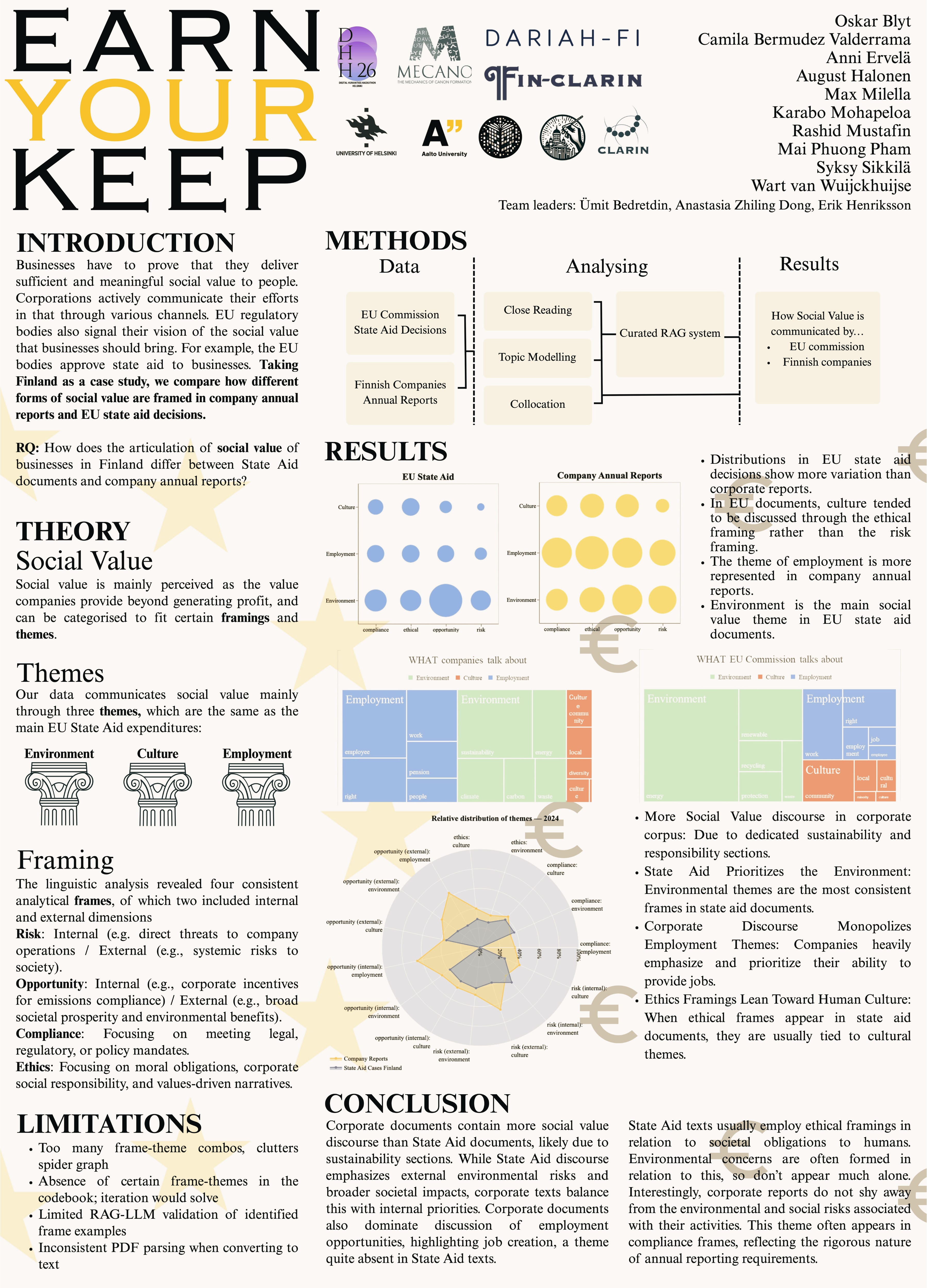
Essentially, what they built over a week compares how social value is framed by regulators and by companies, setting European Commission state aid decisions on Finland against the annual reports of three of the country’s best-known firms: Nokia, the telecoms equipment maker; Outokumpu, a stainless steel producer; and Finnair, the national carrier.
Max’s summary of their contributions, from the slides he presented on their return, credits Karabo with all things topic modelling, the early analysis and the visualisations. Max, meanwhile, pored over the corpus analysis, close textual analysis and an automated annotation schema, while also leading on the group presentations. That is, he distilled the iterative musings of ten people out of linguistics, computer science, econometrics, statistics and communications into cohesive progress reports at every checkpoint of the week to a room of peers.
They found that companies talk employment where the Commission talks environment, and that while corporate reports address environmental and social risk, it’s usually within the frame of compliance. The group’s own limitations section notes that the annotation, where a language model labelled passages using a reference codebook, was never properly validated. That’s worth mentioning, though par for the course in a hackathon setting.
I asked Karabo how often his own research asks him to start from nothing. As it happens, because the context-relevant humanities-meets-computer-science literature he’d want to build on largely doesn’t exist yet, he often finds himself bridging a computer science paper solving a completely different problem, and a humanities paper proposing something else that matters in the humanities.
“So I often have to either tweak the technology to meet this problem, or recontextualise this problem to be solvable with the existing [literature]. It’s just a lot of bootstrapping.” And so, being plonked in a group with no corpus and no question wasn’t exactly hardship for him.
That suggests something hackathon curators in Northern ends may well be on to: a default muscle for building from nothing is not evenly distributed. No doubt it’s pretty handy in a room where every other group inherits a dataset, as is typical.
Curiously, Karabo admits to going in with a presupposition of his own about the humanities crowd. He assumed humanities researchers were simply anti-AI in their methods. But after spending a week putting these tools in front of them in person rather than reading their resistance in a paper, he realised the power of in-person collaboration to bridge the gap between apparently divergent orientations.
“These AI tools have a lot of stochasticity in them. It feels like they’re random at times. For someone coming from computer science, this randomness isn’t scary, because it’s all just data. It’s just a data point, and you treat them [all data points] equally.”
Then the turn. “But for someone that’s in the humanities, this could be people’s opinions. It’s not just a random data point. So, something behaving stochastically on something like that [things people care deeply about] doesn’t bring them comfort.”
His conclusion wasn’t that they should get over it, but rather to find something which achieves the same goal a little more deterministically.
Reading this piece in draft, Max pushed back on Karabo’s interpretation.
“I think that the hesitance towards many machine-learning approaches exhibited by more traditional humanities and social science researchers isn’t so much about discomfort over uncertainty. It’s more a scepticism over the ability to operationalise complex human behaviour into reliably quantifiable and predictable variables.” - Max
He added a second reason, a professional caution against employing “black-box tools they [researchers] aren’t adequately familiar with on a technical level.”
We can call all that a fun peek into the wheels of observation and deduction turning in the heads of an early-career computer scientist and a linguist finding his feet in social data science, both several months into being part of a Digital Humanities Chair.
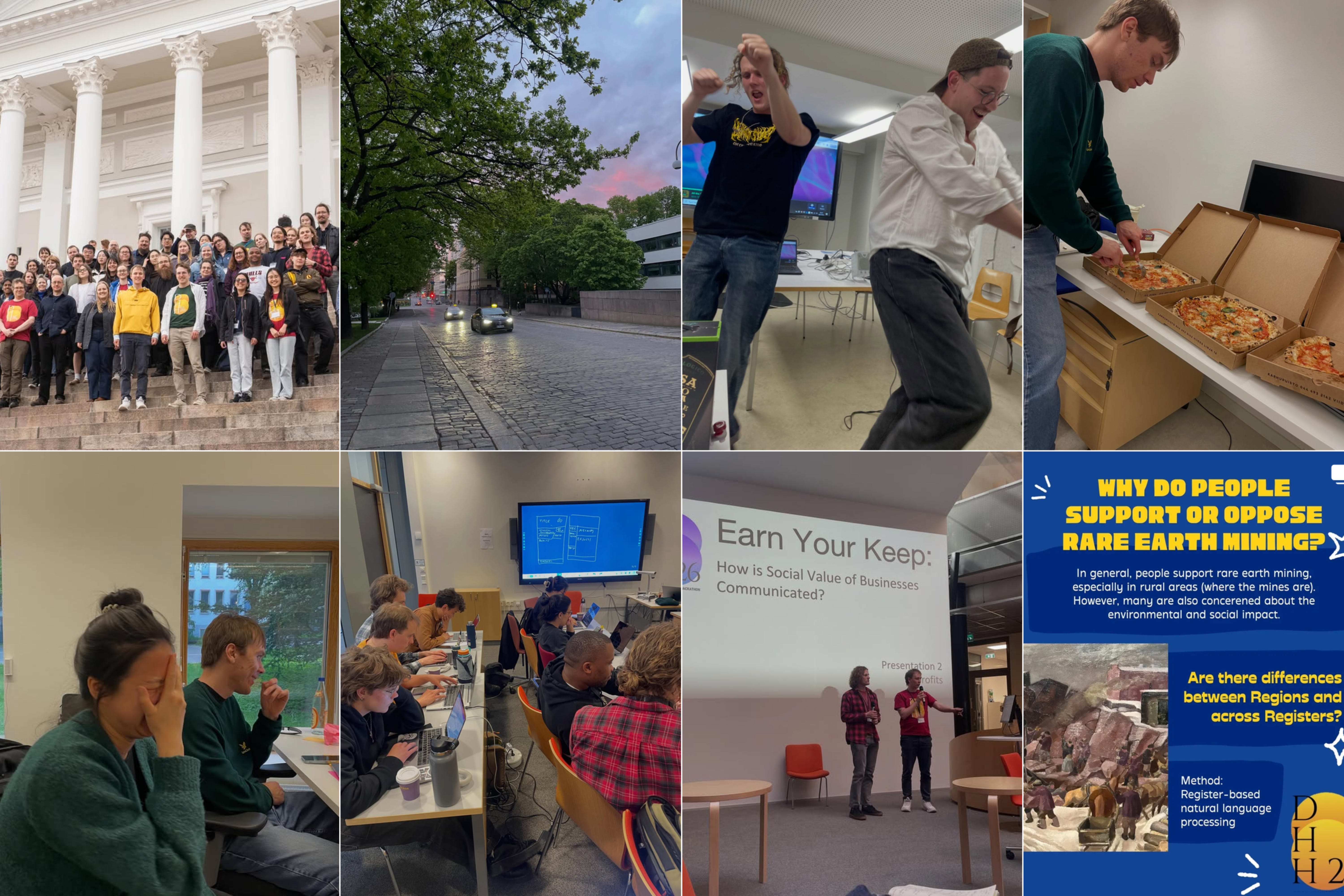
Incidentally, Karabo and Max had been discussing low-resource languages offline since before the trip, and Karabo had already worked the problem at that UNDP hackathon in December, in a project that involved building a corpus for Sesotho.
Most models are trained predominantly on high-resource languages and carry a high-resource perspective on the world. “When you lose the language, you also lose the culture, and a lot about the people.” Translation into English is the current crutch and he uses it himself, because the alternative is letting the problem swallow the project.
“English itself is not representative of the culture you’re looking at. It could be losing completely what it thinks is important in your data.” - Karabo
Models make sweeping assumptions about how all English speakers use the language and draw inferences about what they care about, regardless of where they're from. He argued that this strips away local idioms, and that the way something is expressed in the varieties of English spoken across Africa can carry meanings that differ significantly from those a model would infer from ‘standard’ English.
I asked him four times, in four different ways, what the advantage was of having him in that room.
The first answer declined the frame I put forward. Being external, he said, felt less like a European-African thing than like being a computer scientist in an event full of social scientists. The second, when I pressed on whether it gave him an edge, produced something about augmenting rather than opposing the group’s qualitative leaning. The third circled back to the state aid work.
It’s interesting how the European Commission frames transparency, and worth asking how that runs where, as he puts it, there isn’t as much clarity about how funds move around. “You don’t want to be driving it one way, especially when you’re the minority,” he added. “You’re also a guest in that setting.”
It took a fourth ask, half an hour later, when I finally put it as bluntly as I could manage. Make an objective case for being a (Southern) African in that room. What singular perspective or contribution did you bring? Only then did Karabo give me the answer that had been there all along.
One of the themes he and Max didn’t get assigned was about the role of foreign nations in national policy debate. “Coming from a country that was undergoing a very tense political state around foreign nationals at the time, I could have offered a very rich perspective on that debate.”
This is quite an emphatic research claim about a question he was arguably better placed to answer than the people who set it.
Max had arrived at the same place from the other side, and earlier. Reporting back to the Chair in July, he described one of the first conversations the two of them had after their opening online session.
"We kind of feel a responsibility to bring some Global South perspective into this." - Max
He was also candid that, while in Helsinki, they never put a ton of effort into shifting the gaze away from Europe because they couldn't quite figure out how to helpfully broaden the scope in the time they had. He said this was among the main conclusions he came home with.

When I invited the pair to imagine what a Digital Humanities hackathon convened by the Chair might treat differently, the makings of a brief emerged.
Karabo proposed keeping themes open rather than fixing them in advance. Imagine that... a quant guy proposing wanton boundarylessness.
He noticed that a significant number of participants at the Helsinki event, while studying at European universities, were not European. He reckons that they would have brought invaluable contributions from home had the questions allowed for it. Furthermore, he referenced a formulation he attributes to Benjamin Rosman, professor of machine learning and robotics in the School of Computer Science and Applied Mathematics at Wits, flagging that he’s paraphrasing: African AI should not mean solving African problems with AI, because Africa has a perspective it can bring to the world’s problems.
Then, he would think hard about prizes. While he won thirty-five thousand rand some years back at the RSL gig, he remains ambivalent about it. “Were we the most deserving people of this award? I saw some really impressive solutions.” Awards get participation going, he grants, but they tend to dim the work everybody else did. What he noticed in Helsinki, in the absence of any prize, was that people listened to other groups’ presentations properly rather than waiting for their turn to impress a panel of judges.
“I don’t think anyone can say they did any academic work off of their own brilliance. We’re always building off the brilliance of other people.” - Karabo
Max’s contribution to the brief is about tempo, and he put it to the Chair in July as a set of recommendations. A hackathon in this style at Wits is necessary, but he reckons we needn’t start at a week-long tentpole gathering. And never underestimate how much gets done in a narrow period. 24- to 48-hour sprints, or, less ideally, a few afternoons of intensive work with specific tasks and specific goals, are eminently doable on top of everyone’s usual load, he maintains. He suggested something like 48 hours once a month. Pick small, particular goals and hammer them for two full days, he says, and let people self-organise, drifting towards what they are good at and interested in.
I’d say an open agenda and incentives that promote open collaboration over immediate personal gain from the Digital guy, plus tempo and ritualistic structure from the Humanities guy, make a decent start on the design document for the Digital Humanities hackathon the Chair intends to convene in due course.
Helsinki gave our fellows an immersive look at a well-run hackathon machine, fuelled by eleven editions of institutional memory, an accredited module, supercomputer access and 611 tracked cups of coffee. Now they may well get to help convene a hackathon built around questions only a room full of people who have spent their careers building from nothing (or from a good deal less than a fully resourced start) would think to ask.
